
Your Business Is Moving: How to keep Everyone in the Loop
A comprehensive guide to crafting relocation communications that actually work
After two decades of managing office relocations for everyone from Fortune 500 companies to local medical practices, we’ve discovered something crucial: the difference between a smooth transition and weeks of confusion often comes down to one thing—how well you communicate the change.
Your business move might not involve relocating an MRI machine or coordinating 500 employees across multiple floors, but the fundamentals remain the same. A clear, timely relocation announcement keeps your business relationships intact and your operations running smoothly.
What Your Relocation Letter Must Include
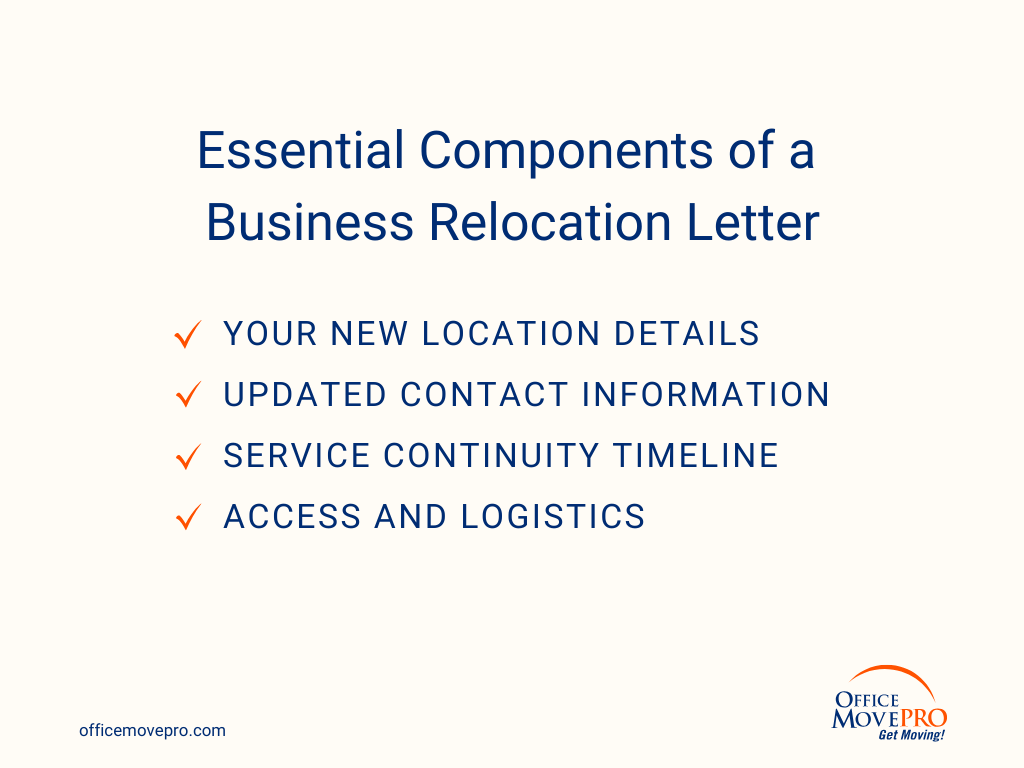
Think of your relocation letter as your command center for information. Every detail matters, but clarity matters most. Here’s what absolutely cannot be missed:
Your New Location Details: Start with the complete address—street, suite number, floor, city, province, and postal code. Double-check that postal code. Then triple-check it. Nothing undermines professionalism quite like mail returned to sender because of a typo.
Updated Contact Information: If any phone numbers, fax lines, or email addresses are changing, spell it out clearly. If they’re staying the same, confirm it. Your clients shouldn’t have to wonder.
Service Continuity Timeline: Be specific about any temporary disruptions. When will you stop receiving shipments at the old location? What’s your last day of operations there? When will you be fully operational at the new site? Precision now prevents panic later.
Access and Logistics: Where should deliveries go? Where can visitors park? If your new location has any quirks—a tricky entrance, specific elevator banks, or designated loading areas—share those details now. For businesses with regular foot traffic, consider including a simple map.
Pro Tip: Create a master document with all this information. Copy and paste from it to avoid errors and ensure consistency across all communications.
It’s Not Just What You Say, It’s How You Say It
Your primary message is straightforward: we’re moving. But how you frame it makes all the difference.
Lead with confidence and optimism. This move represents growth and opportunity—make sure that comes through. Your clients and partners need to know you have everything under control. Any service interruptions are temporary, planned for, and managed.
Consider what this move means for your stakeholders:
- Are you moving closer to your supply chain, potentially reducing lead times?
- Will the new space offer better meeting facilities for client consultations?
- Does the larger facility mean expanded services or faster response times?
Share these benefits but keep them relevant to your audience. Your cleaning service doesn’t need to know about your new conference room, but they do need to know about the new loading dock access.
Timing Is Everything
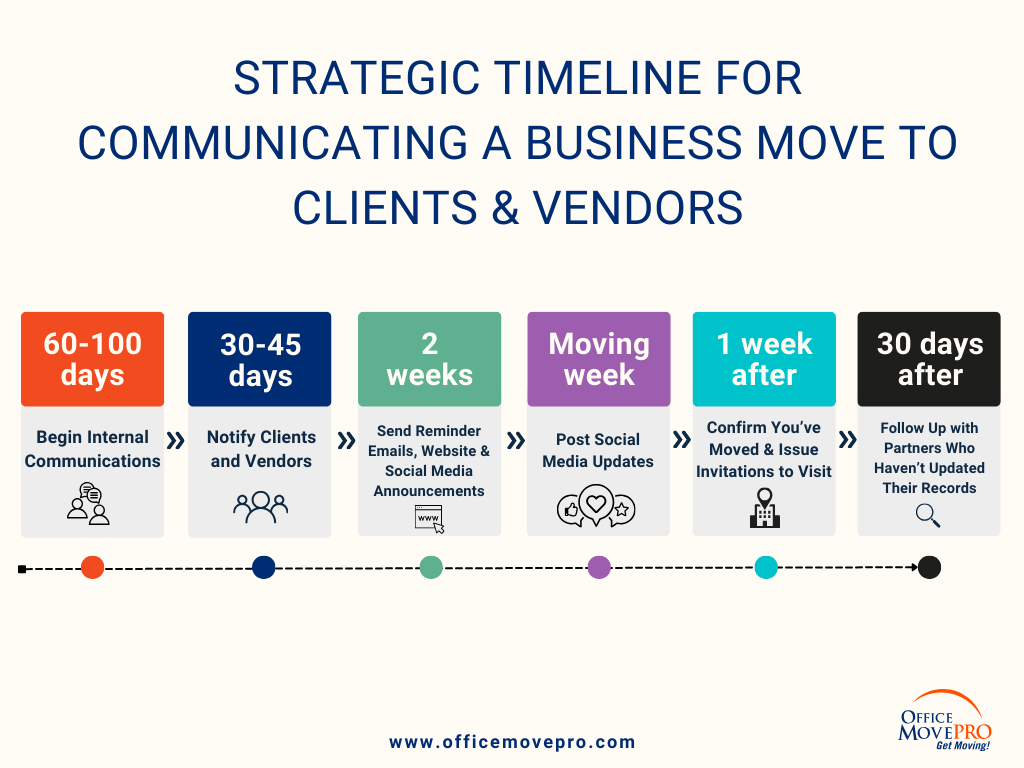
Nobody appreciates last-minute surprises, especially in business. Here’s your strategic timeline:
60 Days Before Moving Day: Start your internal communications. Your team needs to be fully informed before anyone else.
30-45 Days Before: Send official notification letters to all clients, vendors, and business partners. This gives them adequate time to update their systems and adjust any scheduled deliveries or meetings.
2 Weeks Before: Send reminder emails. Update your website with a prominent notice. Begin your social media announcements.
Moving Week: Post real-time updates on your website and social channels. If appropriate, share behind-the-scenes glimpses of the move—it humanizes your business and builds engagement.
1 Week After: Send your “We’ve Successfully Moved!” announcement with a warm invitation to visit your new space.
30 Days After: Final follow-up to any partners who haven’t updated their records, and personal outreach to key clients you haven’t heard from since the move.
Meeting People Where They Are
Your formal letter is just the beginning. Today’s business environment demands a comprehensive communication strategy:
Email Communications: Beyond your formal announcement, update your email signatures immediately. Every message sent becomes a reminder of your new location.
Website Updates: Create a dedicated landing page or banner announcement. Update your contact page, footer, and anywhere else your address appears.
Social Media: Share your moving journey authentically. A packing day photo or a team shot at the new location creates connection and keeps your move top-of-mind.
Traditional Media: Draft a press release for local business publications. Frame it as a growth story—media outlets love success narratives about local businesses.
Business Materials: Update everything from invoices to letterhead. Consistency across all touchpoints reinforces the change.
Different Audiences, Different Approaches
Your communication isn’t one-size-fits-all. Tailor your message to each audience:
For Clients:
- Warm, enthusiastic tone
- Emphasis on continued excellent service
- Benefits they’ll experience
- Detailed access information including parking
- Any changes to business hours
For Vendors and Suppliers:
- Concise, factual approach
- Account numbers and relevant codes
- Specific logistics and delivery instructions
- Key dates for last orders at old location and first at new
For the Community:
- Celebration of growth and commitment to the area
- How the move benefits local employment or services
- Invitation to visit or celebrate (if appropriate)
Your Template Toolkit
Start with this basic structure and customize for your needs:
Opening: Announce the move positively and clearly
Context: Briefly explain why you’re moving (growth, better facilities, improved location)
Details: Provide all essential information (address, dates, contact info)
Impact: Explain any service effects and how you’re managing them
Benefits: Share what improvements clients can expect
Closing: Express appreciation and provide a clear call to action
Remember the following:
- Use headers and bullets for easy scanning
- Bold important dates
- Include your direct contact for questions
- End with a specific request to update their records
Business Relocation Letter Templates
Template 1: Client Notification Letter
[YOUR COMPANY LETTERHEAD]
[Date]
[Client Name] [Client Company] [Address]
Dear [Client Name],
We’re Moving to Serve You Better
We’re thrilled to share some exciting news: [Company Name] is relocating to a new facility that will enable us to better serve your needs and support our continued partnership.
After [X years] at our current location, we’ve outgrown our space—a wonderful challenge that’s directly attributable to clients like you who have placed their trust in us. Our new location offers [specific benefits: expanded facilities/better parking/improved accessibility/larger meeting spaces], all designed with your experience in mind.
Key Information for Your Records:
New Address (Effective [Date]): [Street Address] [Suite/Floor] [City, Province, Postal Code]
Contact Information: Phone: [Remains the same/New number] Fax: [If applicable] Email: [Remains the same/New address]
Service Continuity:
- Last day at current location: [Date]
- Moving dates (limited availability): [Dates]
- First day at new location: [Date]
- Normal operations resume: [Date]
During our transition, we’ve arranged for [specific continuity plans—forwarded calls, temporary service arrangements, etc.]. Your account manager remains [Name] and is available throughout the move at [direct contact].
Visiting Our New Location:
- Parking: [Specific instructions, validation details]
- Building Access: [Entry instructions, suite/floor details]
- Reception: [Location, check-in process]
- Public Transit: [If relevant]
We’ve included a map showing our new location relative to [major landmarks/highways]. The new space is just [X miles/minutes] from our current location.
What This Means for You: [Choose relevant benefits]
- Expanded conference facilities for our meetings
- Improved proximity to [relevant location] reducing delivery times
- Additional staff capacity to enhance response times
- State-of-the-art [relevant facilities/technology]
Action Required: Please update your records with our new address to ensure seamless delivery of any correspondence or shipments after [date]. If you have any standing orders, recurring deliveries, or scheduled appointments, please contact us to confirm arrangements.
We genuinely appreciate your partnership and patience during this transition. This move represents our commitment to growth and continuous improvement in serving you.
If you have any questions or concerns about how this move might affect our work together, please don’t hesitate to reach out directly. We’re here to ensure this transition is as smooth as possible for you.
We look forward to welcoming you to our new location and to many more years of successful partnership.
Warm regards,
[Signature] [Name] [Title] [Direct Phone] [Email]
Template 2: Vendor and Supplier Notification Letter
[YOUR COMPANY LETTERHEAD]
[Date]
[Vendor Contact Name] [Vendor Company] [Address]
RE: Important – Business Relocation Notice – Account #[Number]
Dear [Vendor Name],
Notice of Business Relocation
Effective [Date], [Company Name] will be operating from a new facility. Please update your records immediately to ensure uninterrupted service and delivery.
NEW LOCATION INFORMATION:
Address (Effective [Date]): [Street Address] [Suite/Floor/Building Name] [City, Province, Postal Code]
Shipping/Receiving:
- Loading Dock: [Location/Instructions]
- Receiving Hours: [Hours]
- Dock Phone: [Number]
- Special Instructions: [If any]
Account Information:
- Account Number: [Remains the same]
- Tax ID: [Remains the same]
- Purchase Order Delivery: [Email/contact remains the same or new]
CRITICAL DATES:
- Last delivery to current location: [Date and time]
- Do NOT deliver between: [Moving dates]
- First delivery to new location: [Date]
- Normal operations resume: [Date]
Billing and Remittance: [Choose one]
- Billing address remains the same: [Address]
- New billing address effective [date]: [Address]
Key Contacts:
- Accounts Payable: [Name, phone, email]
- Purchasing: [Name, phone, email]
- Receiving: [Name, phone, email]
Action Required:
- Update our delivery address in your system immediately
- Confirm receipt of this notice by [date] via email to [email]
- Redirect any shipments in transit after [date] to the new address
- Update our account profile with the new service location
Special Instructions for Your Service: [Include specific details relevant to their service – e.g., for cleaning services: new access codes, key pickup location; for IT services: new server room location; for food delivery: new kitchen entrance]
Please confirm that you have received this notification and updated your records by replying to this letter or contacting [name] at [phone/email].
We value our business relationship and appreciate your attention to these important changes. Your cooperation in updating these details ensures continued smooth operations between our organizations.
Thank you for your continued partnership and service.
Sincerely,
[Signature] [Name] [Title] [Direct Phone] [Email]
Attachment: Map to new location CC: Accounts Payable, Receiving Department
Template 3: Community Announcement Letter
[YOUR COMPANY LETTERHEAD]
[Date]
Dear Neighbour,
[Company Name] is Growing in [City/Neighborhood Name]
We’re excited to announce that [Company Name] is relocating within our community, a move that reflects both our growth and our continued commitment to [city/neighborhood].
For [X years], we’ve been proud to call [current location/neighborhood] home. Thanks to the incredible support of our community, we’ve outgrown our current space and are moving to [new address/neighborhood]—just [distance] from our current location.
Our New Home: [Street Address] [City, Province, Postal Code]
Opening at our new location: [Date]
What This Means for Our Community:
This expansion allows us to:
- Create [number] new local jobs over the next [timeframe]
- Expand our [community service/partnership] programs
- Better serve the [number] of local [customers/clients/families] who rely on us
- Continue investing in [specific community involvement]
Our Commitment Continues:
While our address is changing, our dedication to [city/neighborhood] remains constant. We’ll continue to:
- Support [specific local organizations/events you sponsor]
- Partner with [local schools/nonprofits/organizations]
- Source from local suppliers whenever possible
- Participate in [community events/initiatives]
You’re Invited:
We’d love to show you our new space and thank you for your support over the years. Please join us for:
Community Open House [Date and Time] [New Address]
Stop by for refreshments, tours, and a chance to meet our team. We’ll also be collecting donations for [local charity] as part of our moving celebration.
A Thank You to [Current Neighborhood]:
We want to express our sincere gratitude to our neighbors at [current location] who have made us feel welcome for [timeframe]. The relationships we’ve built and the memories we’ve created will move with us.
Welcome to New Neighbors:
To our soon-to-be neighbours at [new location], we look forward to becoming a positive part of your business community. We pride ourselves on being good neighbors and maintaining a [clean, quiet, professional] presence.
This move represents not just our growth, but our belief in the bright future of [city/region]. We’re proud to be a [city] business, and we’re excited about this new chapter in our story here.
If you have any questions about our relocation or would like to learn more about what we do, please don’t hesitate to reach out at [phone] or [email].
Thank you for being part of our journey.
With gratitude and excitement,
[Signature] [Name] [Title] [Company Name]
P.S. Follow our moving journey and get updates about our open house on [social media handles].
Quick Usage Guide:
For Clients: Send 30-45 days before move. Focus on continuity of service and benefits. Include map. Follow up with reminder 1 week before.
For Vendors: Send 45-60 days before move. Prioritize operational details and deadlines. Require confirmation. Include accounts payable in communication.
For Community: Send 30 days before move or upon opening. Focus on positive economic impact and community involvement. Consider sending to local business associations and neighborhood groups.
Customization Tips:
- Replace all bracketed placeholders with your specific information.
- Remove any sections that don’t apply to your situation.
- Adjust tone slightly based on your industry (more formal for financial services, warmer for retail).
- Add company-specific details that reinforce your brand values.
- Consider printing client letters on letterhead and hand-signing for key accounts.
Common Pitfalls and How to Avoid Them
Learn from others’ mistakes:
Never announce before contracts are signed. That dream space isn’t yours until the ink is dry.
Don’t bury the lead. If you’re moving, say so clearly in your subject line and opening paragraph.
Avoid information overload. While you want to be thorough, don’t cloud your main message with promotions or unrelated updates. Save the “moving sale” for a separate communication.
Don’t assume people will “figure it out.” Be explicit about every important detail.
Never skip the proofread. Have someone outside your organization review the letter. Fresh eyes catch what familiar ones miss.
The Human Touch in Professional Communication
While maintaining professionalism is crucial, remember that businesses are run by people. People appreciate consideration, clarity, and even a touch of personality. Your move is a milestone—it’s okay to let some pride and excitement show through.
If something goes sideways during the move (and something always does), a bit of transparent communication can actually strengthen relationships. “Our phones will be down an extra day, but our mobile lines are working and we’re committed to keeping you supported” shows both humanity and dedication.
Creating Your Action Plan
Make communication part of your moving project timeline, not an afterthought. Here’s your checklist:
- [ ] Assign one person as the communication point person
- [ ] Create your master information document
- [ ] Draft your various letter templates
- [ ] Build your communication timeline
- [ ] Prepare your digital updates
- [ ] Plan your follow-up strategy
- [ ] Brief your entire team on the messaging
The Follow-Through: Where Great Relationships Are Built

Sending the announcement is just the beginning. Your follow-through demonstrates your professionalism:
- Track who has acknowledged the change
- Have a plan for mail forwarding
- Prepare your team to handle questions consistently
- Monitor and respond to feedback
Celebrate the successful transition with your stakeholders
Final Thoughts: Your Move, Your Opportunity
A business relocation is more than a logistical exercise—it’s a chance to reinforce your professionalism, demonstrate your growth, and strengthen relationships with everyone in your business ecosystem.
Handle it with the attention it deserves, and you’ll find that what could have been a headache becomes an opportunity to showcase exactly why people choose to do business with you.
Remember: Be clear. Be timely. Be yourself.
Your clients and partners will appreciate the consideration, and you’ll start your new chapter with relationships not just intact, but strengthened.
Need help planning your business move? We’ve managed thousands of relocations and know that every detail matters. Reach out to discuss how we can make your transition seamless—from the physical move to every communication in between.